
The story behind Tikiri
Here's why Tikiri exists.
It started as a bedtime worry. Every night I sing my son Sinhala rhymes like "Nil Ahas Thale" and read him his favorite books, the Little Blue Truck ones, the Mister Rogers ones, over and over. Those are my favorite minutes of the day. But somewhere in the quiet I kept landing on the same thought: he loves the melody, but he doesn't know the words. And if I'm not careful, he never will.
That worry has roots. I moved to America when I was thirteen, and my dad and my family gave up more than I can ever repay to get us here. I've spent most of my life in English ever since. Sinhala stayed the language of home, but English took over everything else. Now I'm a dad in a house that runs in English, married to a wife who isn't Sri Lankan, with my parents speaking a little Sinhala to my son when they visit. It's a wonderful life. It's also exactly how a language quietly slips away.
So I went looking for help, and that's where it got frustrating. There's so much lovely stuff for kids learning Spanish, the toys, the books, the videos, the apps, all made with real care. I wanted that for Sinhala and couldn't find it. I even asked my parents to bring books back from Sri Lanka. They did, and I'm grateful, but the art and quality weren't quite what I was hoping for. Nothing felt good enough to hand my kid.
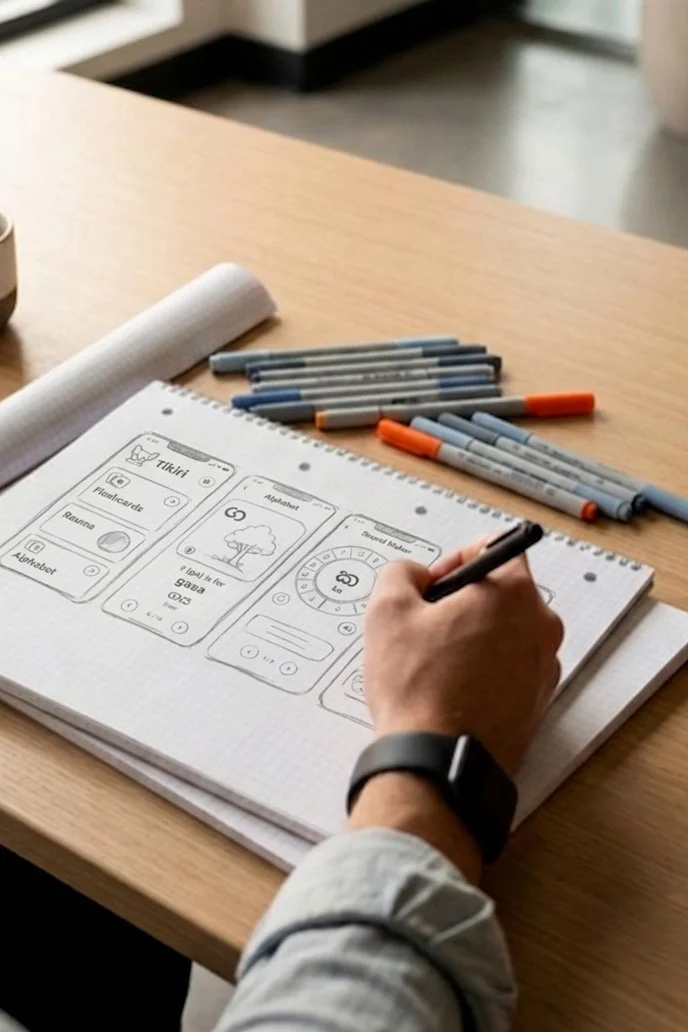
So I figured, why am I waiting around. I work in graphic design, web development, and IT, with a lot of UI/UX along the way, so why not just build this myself. I'm a designer more than an app developer though, so I vibe coded my way through it, building Tikiri piece by piece with AI models as my pair programmer. My wife spent years as a fourth grade teacher, and she shaped how it actually works: how words are grouped, how much to show at once, how to keep a two year old engaged without overwhelming them. The look comes from the warm, hand-painted feel of shows like Puffin Rock, because kids can always tell when something was made with care.
I never meant Tikiri to be a course, and it isn't one. It's a gentle companion, a little corner to keep Sinhala close and fun, something to sit alongside the songs, the books, and the family voices that carry a language along. Inside there are flashcards for first words, an alphabet mode for the Sinhala hodiya, a soft picture quiz, and everyday phrases, with a native speaker saying the words, letters, and phrases aloud so they're easy to hear and say together. And because home means different languages for different families, every card can show its meaning in the language you already speak, English, Tamil, Hindi, Spanish, Arabic, and more, while the Sinhala stays exactly as it is. A Tamil-speaking grandma in Colombo, a curious traveller, or a parent in the diaspora can all pick up the same card and share it.
And yes, it's free. On purpose, forever. I feel lucky to have the life I have, and Tikiri is my little thank you to where I came from. It's my very first app, and I wanted it to be something any parent can just pick up and use to pass our language on, no cost, no catch, and no ads cluttering up a screen meant for a kid. This is only the beginning too. I have a long list of features and ideas I can't wait to add, so Tikiri will keep growing right alongside your little one.
It's the most personal thing I've ever made. Thanks for being here, and I hope your little one loves it as much as mine does.
Credits
A few honest notes on how Tikiri came together:
Designed & created by: Rakitha Perera.
Early-learning guidance: Tiffany Hilk.
Voice recordings: Rakitha Perera.
Vibe coded with help from Claude Opus 4.8+ and Fable.
Watercolor artwork: made with Midjourney, with a little Nano Banana.
Fonts: Baloo 2, Nunito, and Noto Serif Sinhala (open-source Google Fonts).